Open-Cell vs Closed-Cell Spray Foam: Full Comparison Chart
A detailed side-by-side comparison of every key performance metric for North Texas homes and buildings.
Choosing between open-cell and closed-cell spray foam is one of the most important decisions in any insulation project. This chart breaks down every meaningful comparison point so you can make an informed decision for your specific structure and climate.
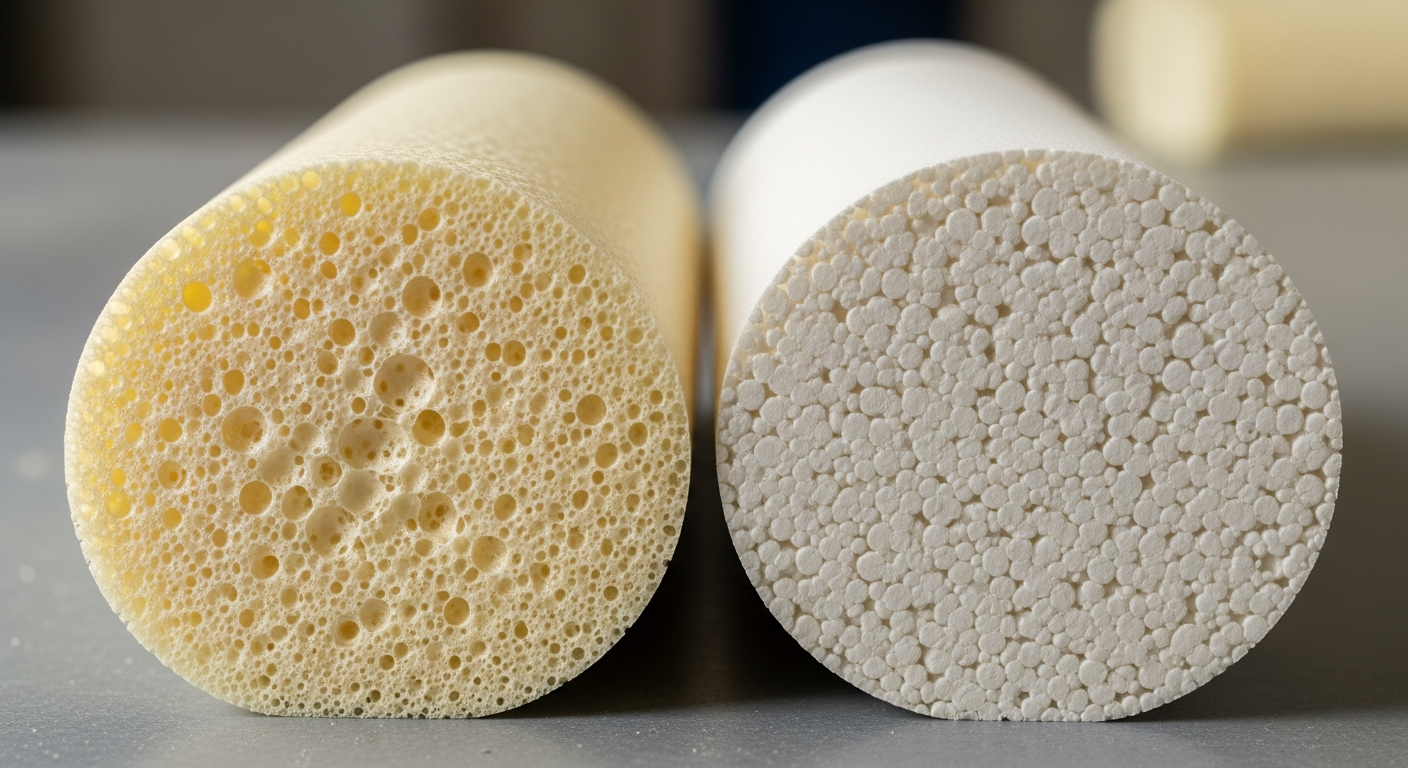
R-Value Per Inch
Open-cell spray foam delivers approximately R-3.5 to R-4 per inch. Closed-cell delivers approximately R-6 to R-7 per inch.
This means that to achieve R-21 in a wall, you need roughly 5.25 inches of open-cell or only 3 inches of closed-cell. For shallow framing depths, closed-cell is often the only practical option.
Air Sealing Performance
Both open-cell and closed-cell spray foam provide excellent air sealing. This is the most significant advantage both products have over fiberglass and blown insulation.
Air sealing performance is where spray foam most dramatically outperforms traditional insulation, especially in North Texas attics, rim joists, and crawl space assemblies.
Vapor Permeability
Open-cell is vapor permeable. Moisture can move through it. This is actually an advantage in many roof deck assemblies because it allows inward drying when the roof is wet.
Closed-cell acts as a Class II vapor retarder, blocking most vapor movement. This is critical in crawl spaces, rim joists, metal buildings, and anywhere condensation control is the priority.
Structural Rigidity
Closed-cell foam adds measurable structural strength to the assembly. It bonds the substrate together and adds racking resistance. This is especially valuable in metal buildings, shallow wall assemblies, and post-frame structures.
Open-cell provides no meaningful structural contribution. It remains soft and flexible throughout its life.
Sound Dampening
Open-cell is the clear winner for airborne sound absorption. Its soft, porous structure absorbs sound waves rather than reflecting them. This is why it is used in media rooms, golf simulators, nurseries, and detached offices throughout DFW.
Closed-cell helps with sound control through air sealing, but it is a less effective sound absorber than open-cell.
Cost
Open-cell is typically less expensive per square foot because it uses lighter-density material, expands more aggressively, and requires less product to fill large cavities.
Closed-cell costs significantly more per board foot due to higher material density, lower yield per set, and the need for multiple lifts in some applications. However, its higher R-value per inch often means less total product is needed to hit a target R-value.
Best Applications: Quick Reference
- Open-cell: attic roof decks under shingles, sound-control walls, media rooms, framed garages, detached offices
- Closed-cell: metal buildings, crawl spaces, rim joists, pole barns, shallow exterior walls, RV garages, cantilever floors
- Mixed systems: open-cell rooflines + closed-cell edge conditions is the most common high-performance DFW strategy
Related Reading
Ready to Choose the Right Foam for Your Structure?
Texas Foam Pro will evaluate your specific structure and recommend the best chemistry, based on how it is built, not a one-size-fits-all approach.